
Faërie as the “middle earth” between the realm of senses and the realm of Ideas
Dr. Diego Klautau
J.R.R. Tolkien’s essay On Fairy-Stories is one of the main sources of the theorical perspective of the author of The Lord of the Rings. Despite being universally recognized for his fictions, the Oxford professor has works of academic investigation in Philology and Literary theory. On Fairy-Stories, published in 1947, is the result of a 1939 conference at the University of St. Andrews, revised and expanded to its completed form in 1943 (FLIEGER; ANDERSON, 2014, p. 23).
Among the countless possibilities of analyzing the text, as I have already mentioned elsewhere (KLAUTAU, 2021, p. 105-182), I have chosen for our “Unexpected Literary Journey” a framework which is crucial for understanding the relationship between Literature and Philosophy according to Tolkien himself: presenting the concept of Faërie, the Perilous Realm. Let us see the philological identification which is presented as the origin of this term.
Fairy, as a noun more or less equivalent to elf, is a relatively modern word, hardly used until the Tudor period. The first quotation in the Oxford Dictionary (the only one before A.D. 1450) is significant. It is taken from the poet Gower: as he were a faierie. But this Gower did not say. He wrote as he were of faierie, ‘as if he were come from Faërie’. Gower was describing a young gallant who seeks to bewitch the hearts of the maidens in church. (TOLKIEN, 2014, p. 30)
The first important aspect is that the word “fairy” is considered equivalent to “elf,” as quoted in the 14th century. Then, it is important to notice that it does not refer to a person, but to a place. This is Tolkien’s starting point for investigating this Realm, whose definition, deliberately imprecise, is a place metaphor.
According to Aristotle’s Poetics, “metaphor is applying to something a noun that properly applies to something else” (ARISTOTLE, 1457b), and Tolkien identifies Faërie with the name “Realm,” that is, a place, as a physical space delimited by borders or a geographical point. However, this transfer of the noun “place” to refer to this reality is not proper or literal, for it is the very author of The Hobbit that affirms that this reality cannot be defined, so that his aim would only be to describe “some glimpses of [his] own imperfect vision” about this topic. Thus, it is once again possible to notice this metaphor elsewhere in the essay, when Faërie is presented in the context of fairy-stories as they are found in the folk and oral traditions of Europe.
[…] fairy-stories are not in normal English usage stories about fairies or elves, but stories about Fairy, that is Faërie, the realm or state in which fairies have their being. Faërie contains many things besides elves and fays, and besides dwarfs, witches, trolls, giants or dragons: it holds the seas, the sun, the moon, the sky; and the earth, and all things that are in it: tree and bird, water and stone, wine and bread, and ourselves, mortal men, when we are enchanted. (TOLKIEN, 2014, p. 32)
Thus, the narratives collected by Anthropology, Comparative Philology or Literature do not have as a proper object of research accounts about fairy-like or elvish characters, but about a place, in that metaphorical sense — which, in more conceptual terms, Tolkien presents as “the realm or state in which fairies have their being.”
Well, here we find the first reference to the connection with Philosophy, and which is our starting point for my hermeneutic thesis. What is Tolkien referring to with this transfer of the noun “realm?” What is Faërie a metaphor for? What, after all, does it mean “to have their being?”
This latter expression is very common in the Realist Philosophy, or, roughly, the Platonic and Aristotelian tradition, which extends until its Medieval Christian formulations, as in Augustine and Thomas Aquinas. This is what we name Ontology, the study of Being — which, in other words, refers to the investigations about essence, nature or principles of things, and is aligned with the field of study of this tradition known as Metaphysics, the study of the more fundamental principles and laws, which rule all of reality.
The option for this hermeneutics is justified by Tolkien’s historical context, because he was born in the end of the 19th century and had a Catholic education in an English environment marked by the renewal of the Realist tradition. This philosophical retrieval was expressed, in the Roman Catholic Church in general, by the exhortation by Leo XIII in favor of Thomism, and, in the Catholic Church in England in particular, by the retrieval of Patristics promoted by John Henry Cardinal Newman.
In this sense, one can find, alluding to the philological method of archaeology of the word, the use of place metaphor in a discussion on Ontology and Metaphysics, in one of the founding texts of the Realist tradition, Plato’s Republic.
Let’s say, then, that this [the Sun] is what I called the offspring of the good, which the good begot at its analogue. What the latter is in the intelligible realm in relation to understanding and intelligible things, the former [the Sun] is in the visible realm in relation to sight and visible things. (PLATO, 508b-c)
This brief excerpt from Book VI refers to the well-known division of reality made by Plato, between the realm of senses and the realm of Ideas. To put it shortly, that which one captures through their five senses (sight, hearing, touch, taste, and smell) is just a part of the Real (of Being) — and the most fragile part, for it is mutable and inconstant. The more perennial and substantial reality should be found in another dimension of existence, under the name of intelligible world, the access to which would only be given someone through their intelligence — which would capture, by means of dialectics, the essences, forms, or Ideas that ground the being of the images one has in the world of senses.
Returning to Faërie, how could one identify this “realm or state in which fairies have their being?” Are fairies and elves part of the world of senses or the world of Ideas? In order to proceed in our investigation, we should return to Tolkien’s essay.
The definition of a fairy-story – what it is, or what it should be – does not, then, depend on any definition or historical account of elf or fairy, but upon the nature of Faërie: the Perilous Realm itself, and the air that blows in that country… For the moment I will say only this: a ‘fairy-story’ is one which touches on or uses Faërie, whatever its own main purpose may be: satire, adventure, morality, fantasy. (TOLKIEN, 2014, p. 32)
Here it seems that Faërie is a realm in the world of Ideas, for Tolkien affirms that what matters is its nature, and not only the historical data detected in the world of senses. However, the last word in this quote, “fantasy,” drives us to a pathway that might deepen our understanding. Thus, let us join another great exponent of the Realist tradition, Aristotle, in his study on the human soul, De Anima (On the Soul).
[…] imagination is different from perception and cognition; and it does not occur without perception, and without it there is no judgement. It is evident that it is not the same process of thinking as judgement. For it is an affection which is up to us to bring about whenever we wish (for it is possible to produce it before the mind’s eye, just as people create resemblances and arrange them in the arts of memory), but it is not under our control to hold a belief; for we must either arrive at falsehood or truth. (ARISTOTLE, 427b16-b23)
First, Aristotle reminds us that the word “fantasy” comes from the Greek and can be literally translated as “imagination.” Second, that imagination (phantasia) is related to memory, that is, our capacity to produce images in our soul, whether to remind us of something that is no longer in our senses, or to elaborate our judgements and thoughts with the data we capture in the world of senses. Third, let us note that this Aristotelian term refers to production, that is, something made by our soul, which is not naturally present neither in the world of senses nor in the world of Ideas — i.e., something new, manmade.
This is not the place to elaborate on how Plato and Aristotle are philosophically different. Although those differences are important both for theory of knowledge and ontology and metaphysics, our aim is to interpret the reality of Faërie in Tolkien, who is openly working with metaphors — an imperfect glance — and, thus, many times he transits indiscriminately, without care or considering the philosophical difficulties between those two Greek authors.
That said, let us note that, for Aristotle, imagination takes an intermediary place between the perception of the senses and the abstraction of Forms, essences, or Ideas. Well, it would be possible to metaphorically transpose this intermediation between senses and Ideas in the human soul for a middle-earth between the world of senses and the world of Ideas. This interpretation allows us to understand what Tolkien means by “the realm or state in which fairies have their being.” In order to corroborate my thesis, let us turn to Aristotle’s On the Soul.
[…] imagination will be a movement brought about by actual perception. Since sight is the premier sense, imagination [phantasia] has received its name from light [phaos] because without light it is impossible to see. And because imaginings persist and are similar to perceptions, animals do many things according to them, some (namely beasts) because they are not capable of thought, and others (namely human beings) because their mind is clouded at times by passion, sickness, or sleep. (ARISTOTLE, 428b30-429).
Imagination (phantasia) begins with the preservation of images captured by the senses in memory, which reproduces them in the mind when they are no longer present to the eyes. Those images linger in the soul even when what was perceived is no longer in sight, orienting actions, and thoughts. That is why Aristotle links the etymology of phantasy with light (phaos), for imagination illuminates the soul, retrieving the images in memory, when the eyes no longer can see things. It is possible to bring up the connection between Plato’s Sun as the offspring of the good, for both of them cast a light which allows man to access things, whether vision in the world of senses or intelligence in the world of Ideas.
Coming to the end of our lecture — after identifying Faërie as this intermediary dimension of reality linked to imagination (which, although being an abstraction, and thus closer to the world of Ideas, is objectively derived from the world of senses) —, let us see how this specificity of imagination as producer of beings helps us understand the world of elves.
The human mind, endowed with the powers of generalization and abstraction, sees not only green-grass¸discriminating it from other things (and finding it fair to look upon), but sees that it is green as well as being grass. But how powerful, how stimulating to the very faculty that produced it, was the invention of the adjective: no spell or incantation in Faërie is more potent. And that is not surprising: such incantations might indeed be said to be only another view of adjectives, a part of speech in a mythical grammar. The mind that thought of light, heavy, grey, yellow, still, swift, also conceived of magic that would make heavy things light and able to fly, turn grey lead into yellow gold, and the still rock into a swift water. If it could do the one, it could do the other; it inevitably did both. (TOLKIEN, 2014, p. 41)
The productive process of the mind, according to Tolkien, calls to mind the Aristotelian elaboration of (1) generalization, (2) abstraction, (3) discrimination and (4) contemplation — that is: (1) observing individual beings and their unification in a generic image preserved in memory; (2) extracting (abstracting) this generic image of form, essence or universal Idea that identifies this being as unity that unifies individuals of the same species; (3) discriminating between the essential or substantial elements of the being and their variable or accidental traits; and (4) the aesthetical and intellectual appreciation of reality, that is, contemplation.
This Aristotelian dynamics of knowledge to which Tolkien alluded is followed by the metaphor of magic, incantation, or spell of language — specifically by the importance of the adjectives of things, that is, their qualities. Indeed, the most powerful character of Faërie is elaborating language in a mythical grammar, a wonderful and fantastic grammar.
When we can take green from grass, blue from heaven, and red from blood, we have already an enchanter’s power — upon one plane; and the desire to wield that power in the world external to our minds awakes. It does not follow that we shall use that power well upon any plane. We may put a deadly green upon a man’s face and produce a horror; we may make the rare and terrible blue moon to shine; or we may cause woods to spring with silver leaves and rams to wear fleeces of gold, and put hot fire into the belly of the cold worm. But in such ‘fantasy,’ as it is called, new form is made; Faërie begins; Man becomes a sub-creator. (TOLKIEN, 2014, p. 41-42)
Indeed, elaborating on the metaphor of magic, incantation, or spell, one can say that Faërie is this world of imagination concretized or embodied by the language of man. Thus, the access one has to Faërie is made, on the one hand, through fairy-stories historically constituted by men, whether by written texts or oral narrative, and, on the other, through the endless possibilities of the mythical grammar of language as the fertile source of new combinations of qualities, forms and adjectives that allow the making of new literary works of fantasy, whose end and purpose is precisely the contemplation of reality from the perspective of the “enchanter’s power” of language. Lastly, let us return to the Republic to recover the purpose of the Realm of elves.
Socrates: Let that, then, be our defense for our return to the topic of poetry, which shows that, given her nature, we were right to banish her from the city earlier, since our argument compelled us. But let’s also tell her — in case we are charged with some harshness and boorishness — that there is an ancient quarrel between poetry and philosophy… All the same, let it be said that, if the imitative poetry that aims at pleasure has any argument to show it should have a place in a well-governed city, we would gladly welcome it back, since we are well aware of being charmed by it ourselves. Still, it is not pious to betray what one believes to be the truth. What about you, my friend; aren’t you also charmed by it, especially when it is through Homer that you look at it? (PLATO, 607b-c)
Socrates: Then we will surely allow her defenders — the ones who are not poets themselves, but lovers of poetry — to argue without meter on her behalf, showing that she gives not only pleasure but also benefit both to constitutions and to human life. Indeed, we will listen to them graciously, since we would certainly profit if poetry were shown to be not only pleasant but also beneficial. (PLATO, 607c-d)
Beyond the Tolkienian use of the metaphor of enchantment to refer to the poetic language, and the emphasis on the sovereignty of philosophy over poetry, Plato concedes a breach in his known criticism to poets, assembling a defense of the mythmakers of their city. To sum up, I conceive, in a general way, the aim of the Tolkienian Faërie as middle-earth between the world of senses and the world of Ideas as an answer to Plato.
Redeemed Man is still man. Story, fantasy, still go on, and should go on. The Evangelium has not abrogated legends; it has hallowed them, especially the ‘happy ending.’ The Christian has still to work, with mind as well as body, to suffer, hope, and die; but he may now perceive that all his bents and faculties have a purpose, which can be redeemed. So great is the bounty with which he has been treated that he may now, perhaps, fairly dare to guess that in Fantasy he may actually assist in the effoliation and multiple enrichment of creation. All tales may come true; and yet, at the last, redeemed, they may be as like and as unlike the forms that we give them as Man, finally redeemed, will be like and unlike the fallen that we know. (TOLKIEN, 2014, p. 78-79)
Much more could be advanced from the Tolkienian theory, both in aspects of science of religion, philosophy, or theology. However, this brief halt in our journey already accomplished its aim. I hope we can resume our pilgrimage being more attentive to, and contemplating, the marvels of reality, sensorial, elvish, or ideal.
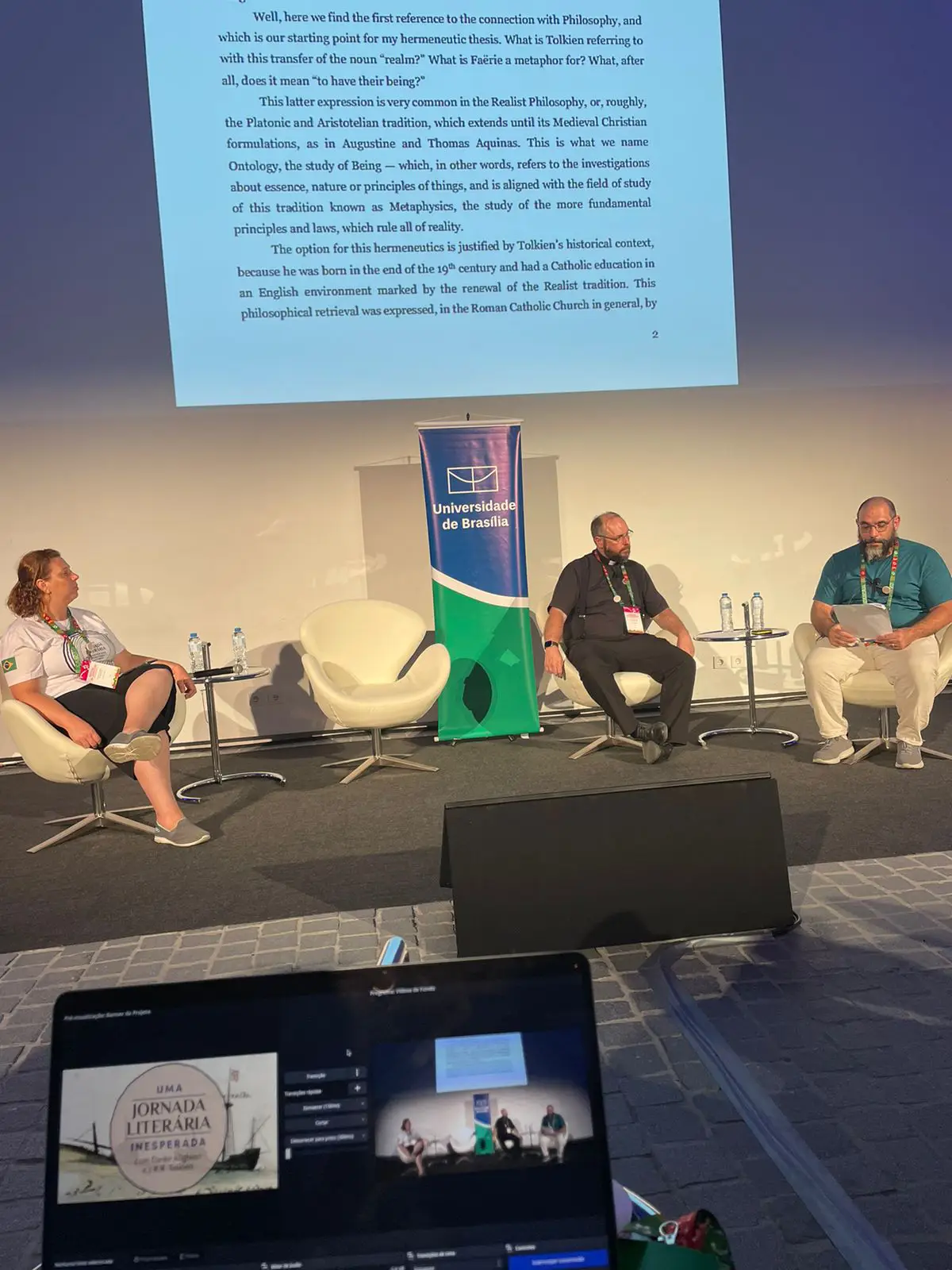
This text is the result of a conference held by the study group Jornada Literária Inesperada [Unexpected Literary Journey] at the World Youth Day – Lisbon/2023.
Bibliography
ARISTOTLE. On the Soul and Other Psychological Works. Translated by Fred D. Miller, Jr. Oxford: Oxford University Press, 2018.
ARISTOTLE. Poetics. Translated by Anthony Kenny. Oxford: Oxford University Press, 2013.
FLIEGER, Verlyn; ANDERSON, Douglas A. Tolkien On Fairy-stories. Expanded edition, with commentary and notes. London: HarperCollins, 2014.
KLAUTAU, Diego. Metafísica da Subcriação: A Filosofia do Mito em J.R.R. Tolkien. São Paulo: A Outra Via, 2021.
PLATO. Republic. Translated by C. D. C. Reeve. Indianapolis/Cambridge: Hackett Publishing Company, 2004.
TOLKIEN, J.R.R. On Fairy-Stories. In: FLIEGER, Verlyn; ANDERSON, Douglas A. Tolkien On Fairy-stories. Expanded edition, with commentary and notes. London: HarperCollins, 2014.
 On fairy-stories